
Juan Brunetta has been linked with a possible future Mexico call-up, but reported interest is not confirmation that he can already play for El Tri. As of the October 29, 2026 checks for this guide, the public reports describe a possible naturalization and eligibility pathway, rather than a completed Mexican nationality process and FIFA approval.
The useful distinction is between nationality, the required connection to Mexico, permission to change national associations where necessary, and selection by the coach. Those are separate steps. A headline projecting 2027 should not be read as a guaranteed debut date or evidence that the paperwork is already complete.
What has actually been reported about Brunetta and Mexico?
The current story is reported conversations about a future possibility. On October 27, Cesar Luis Merlo reported in AM/Super Deportivo that Brunetta and Rafael Marquez had held talks, with naturalization steps under discussion. The report attributed its information to sources close to those conversations. That is newsworthy, but it is different from a federation announcement confirming that every eligibility requirement has been fulfilled.
Fox Sports also reported interest from the player and Mexico's coaching staff on October 27, while describing the process as something that would take time. Subsequent coverage discussed his residence and previous Argentina appearances. Several outlets repeating a proposed pathway do not turn that pathway into an approved FIFA decision.
Interest, an application and a call-up are different developments
Interest means a player or coach is considering the possibility. An application means a particular authority has been asked to process a defined request. Approval means that authority has reached the necessary decision. A call-up is the coach's selection for national-team activities. Those words should not be used interchangeably, even when the overall direction of a report sounds positive.
For example, a discussion about obtaining citizenship does not establish that the naturalization letter has been issued. A report that officials are checking a player's history does not show that FIFA has approved a change of association. Even a future citizenship announcement would answer only part of the football eligibility question. Each development needs its own evidence.
The same applies to a coaching visit. Learning about a player's circumstances can be sensible preparation for a long-term option; it is not a waiver of the rules. Supporters should be cautious when a headline compresses that preparatory work into “Brunetta will play for Mexico,” particularly if it attaches an exact debut month without a decision supporting it.
There is room to discuss the football appeal of the idea while preserving those distinctions. Brunetta is an established attacking midfielder in Mexican club football, and his performances can explain why a coach would investigate his situation. That discussion does not require pretending he has already worn Mexico's shirt or personally confirmed every detail attributed to unnamed sources.
For now, his confirmed club context remains the useful place to follow his performances. The Liga MX fixture list tells supporters when to watch the next league round. A projected Mexico future belongs in a conditional discussion until the nationality, sporting eligibility and selection milestones become concrete.
Mexican nationality is the first requirement, not the whole test
Brunetta would need to hold the relevant Mexican nationality before representing Mexico. A club contract, a residence permit or several successful seasons in Liga MX do not replace nationality. FIFA's framework begins with that basic condition, then applies the additional sporting requirements relevant to the player's circumstances.
A coach cannot grant citizenship or sporting eligibility
Mexican naturalization is handled by the country's competent authorities, including the Secretariat of Foreign Affairs, known as SRE. The national-team coach can express interest in selecting a player and officials can help establish what documentation is needed. Neither action itself grants citizenship. FIFA, in turn, governs the sporting eligibility question rather than deciding who becomes a Mexican citizen.
This is why the naturalization letter matters as a completed milestone. Starting a procedure, arranging documents and receiving a decision are different stages. Reporting that somebody is preparing an application should not be rewritten as “he is already naturalized.” Nor can the length of a club contract tell supporters when the state will decide an individual application.
The nationality and football residence requirements should also be kept apart. SRE provides a naturalization route for people originating from a Latin American country or the Iberian Peninsula based on at least two years of qualifying documented residence, alongside the other conditions. That is not the same as FIFA's five-year adult-residence pathway. It would be incorrect to claim every Argentine must wait five years merely to apply for Mexican citizenship.
That general distinction does not establish Brunetta's private immigration record or tell us which application has actually been made. The relevant documents and authority must determine his individual position. Supporters do not need access to his private file to understand the football point: satisfying a citizenship route cannot, by itself, remove a separate FIFA eligibility condition.
Likewise, suggestions that federation support could make paperwork faster are predictions about a process, not an exemption from its requirements. A reporter's projected timetable cannot substitute for a naturalization decision or a sporting ruling. If the story develops, each authority's completed step should be identified clearly before attaching a debut date.
These distinctions concern eligibility, not the value of a person's citizenship. A naturalized Mexican is not made less Mexican by having an additional football procedure to complete. For fans following current Liga MX games, the useful question is what stage has actually been completed, rather than whether enthusiasm about a future national-team role sounds convincing.
Why five years in Mexico is discussed without guaranteeing a debut date
The 2027 projections come from Brunetta's reported arrival in Mexican football in 2022 and FIFA's adult-residence pathway. Adding five years explains the headline's logic. It does not certify the exact start of qualifying residence, prove uninterrupted compliance or complete the other nationality and association-change requirements.
Club arrival is a starting clue, not a certified residence record
For a player relying on the adult residence link, FIFA's current rules require at least five years of the relevant physical presence. The commentary makes clear that administrative registration or a nominal address is insufficient where the player was not actually present. A transfer announcement provides useful public context, but it is not a complete residence file.
That does not mean ordinary football travel automatically breaks the period. FIFA recognizes permitted absences, including qualifying employment-related travel and certain personal or medical absences, with the circumstances assessed under its rules. Conversely, an international transfer during the qualifying period can interrupt the residence calculation. Neither “every trip resets the clock” nor “the contract proves everything” is a reliable shortcut.
Brunetta's move between Santos Laguna and Tigres was a move between Mexican clubs. Tigres' own profile records his arrival for the Clausura 2024 after his Santos spell. A domestic club change should not be confused with an international transfer to another association. Even so, the public career timeline cannot resolve every question about the evidence required for his individual residence history.
Nationality residence rules and FIFA residence rules are separate
The state can grant nationality under its applicable naturalization route while football's additional residence condition remains a separate issue. The SRE route for Latin American applicants discussed above is therefore not a two-year shortcut into Mexico's national team. Equally, FIFA's five-year adult-residence requirement should not be rewritten as a universal five-year waiting period before an Argentine can seek citizenship.
A hypothetical player might become a citizen before completing the relevant sporting residence requirement. He would then have answered the nationality question without necessarily becoming immediately available for national-team football. Another player might complete a residence period but still lack nationality or the required sporting decision. The milestones can arrive in different orders.
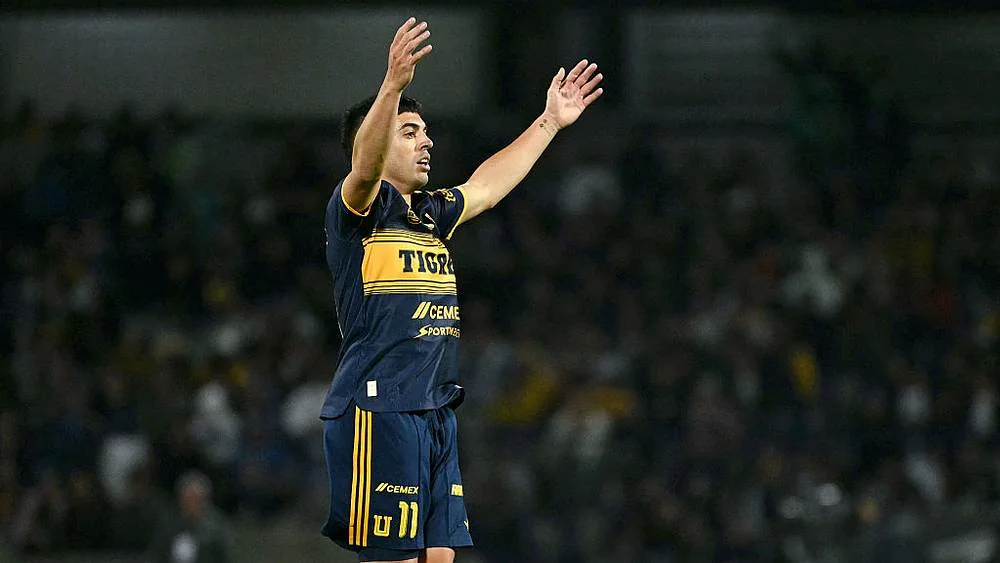
That is why an exact projected month should remain conditional. The public information does not justify promising that Brunetta will be in the first Mexico squad after a particular anniversary. Fans can follow his performances and the Liga MX campaign while waiting for evidence of completed nationality and sporting steps. A change in the projected timetable would not, on its own, prove that FIFA rejected him.
His Argentina appearances make the change-of-association check essential
Brunetta's Argentina history means the question cannot stop at nationality and residence. Participation in an official competition for another national association can create a sporting affiliation even below senior level. A player seeking to represent a different association must then fit an authorized change-of-association pathway; a new passport does not erase the earlier match record.
Youth internationals and senior internationals are not the same case
AFA confirmed Brunetta's addition to Argentina's Pre-Olympic squad in January 2020. Contemporary local reporting also recorded his appearance against Chile in that tournament, while the October 2026 reports identify his Argentina under-23 history as a reason a switch would need examination. Being selected for a squad and actually entering a match are different facts; the appearance record is what matters to the sporting assessment.
The match's status matters too. An official age-group competition is different from a friendly, and an under-23 event is not automatically a senior “A” international simply because the player is an adult professional. FIFA's current explanation distinguishes age-limited competitions from unrestricted senior internationals. The rules for somebody with official senior appearances should not simply be copied onto a youth-only case.
That defeats one common shortcut: “he never played for the senior team, so no permission is needed.” Official participation at another level can still make a change request necessary. It also explains why a complete history is more useful than a cap count that mixes friendlies, unused substitute appearances and official matches together.
The pre-September 2020 exception prevents an age-only conclusion
The current change rules are in article 10. One pathway for a player who did not already hold the new nationality at his first official appearance below senior “A” level normally includes an under-21 condition at his last official appearance for the previous association, alongside the other requirements. Reading that condition alone can produce the wrong conclusion about older historical appearances.
Paragraph 82 of FIFA's September 2026 commentary expressly says that age condition does not apply where the player's last official representative-team match for the former association occurred before September 18, 2020. The commentary's examples preserve the other cumulative requirements. The transition provision therefore removes an age-only objection in the specified circumstances; it does not approve every proposed switch.
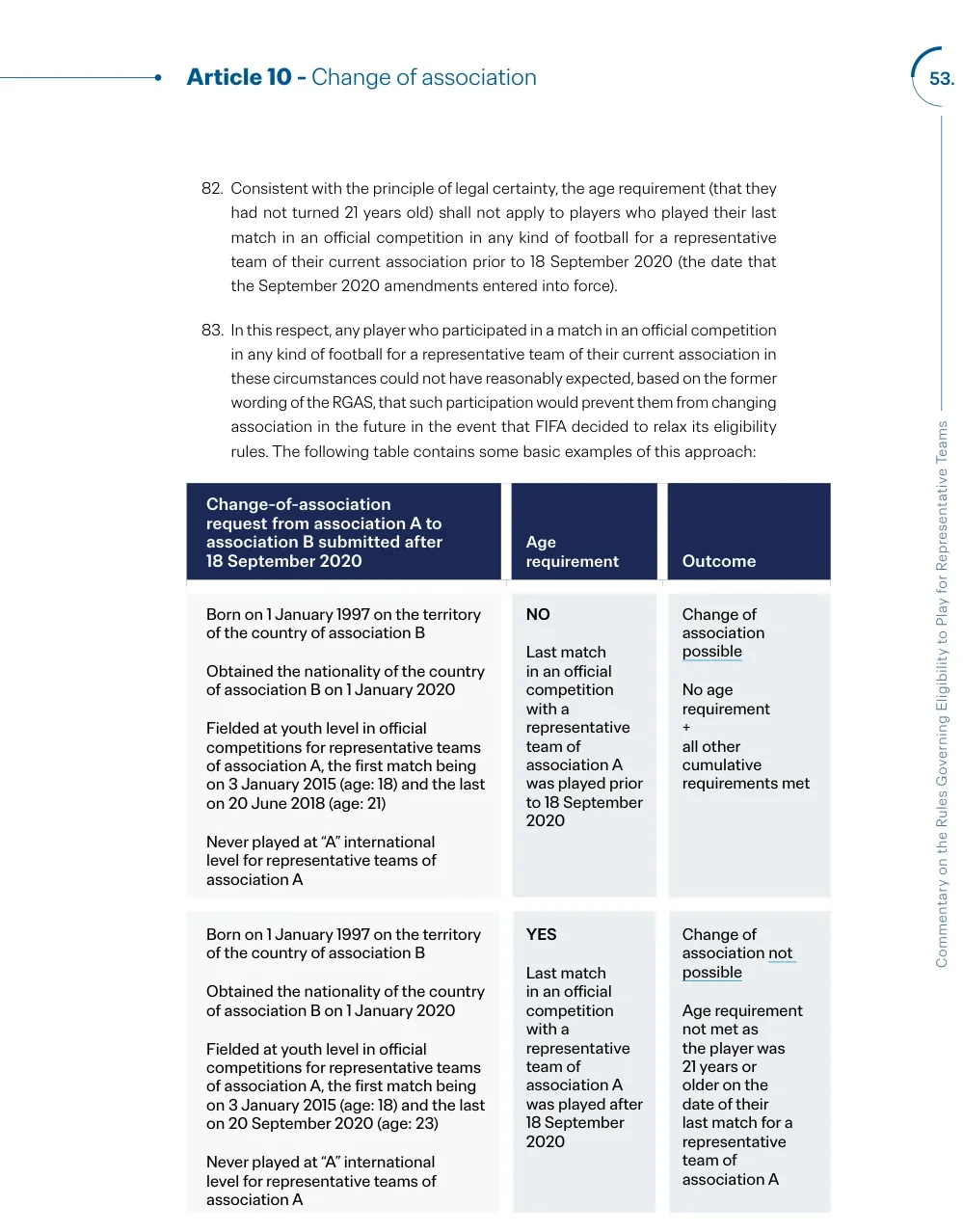
For Brunetta, the proper conclusion is that his complete dated record must be checked against the relevant pathway, including that transition rule where applicable. Neither his current age nor his age during an isolated 2020 appearance settles the entire case. The published reports are not a substitute for a formal review of his last official appearance, nationality history, genuine link and required FIFA decision.
What must happen before a Mexico appearance becomes a real option?
The story becomes materially different when completed milestones replace projected intentions. For supporters, a short checklist is more useful than repeatedly moving an expected debut month. It should track the player's nationality and sporting position separately from the coach's decision about whether he improves a particular squad.
The milestones that would change the story
The relevant association must assemble the player's documents and identify the correct eligibility pathway. Where a change of association is required, the new association submits the request on the player's behalf through FIFA's Legal Portal. A complete file must support the conditions being invoked; simply notifying FIFA that the player wants to switch is not the same as obtaining permission.
- Confirmation that the required Mexican nationality is actually held.
- A documented residence or other genuine-link basis satisfying the applicable sporting rule.
- A complete previous international record, with match dates, level and official status.
- The necessary FIFA decision on the change-of-association request.
- A subsequent Mexico selection decision based on the player's current football circumstances.
FIFA's current guide sets a submission deadline of at least 15 calendar days before the relevant international window. That is a filing requirement, not a promise that every application will be approved within 15 days. Additional documents may be requested. A player who has filed a change-of-association request cannot participate for any representative team while that request remains undecided.
An accepted decision permits participation under the applicable rules; it does not need to wait for publication on FIFA's public change-of-association platform. Conversely, an unfinished request should not be treated as approved merely because a window is approaching. The decision itself and the player's other applicable conditions matter more than a fan-maintained deadline tracker.
Eligibility opens a selection decision rather than guaranteeing a place
The football case for considering Brunetta is understandable. Tigres identifies him as a creative midfielder, and the recent discussion focuses on his ability to connect midfield with attack. If he became available, that profile could offer a coach another option between the lines or behind a striker. It remains a conditional tactical possibility, not evidence of a promised starting role.
Selection would still involve form, fitness, defensive responsibilities and how his role fits the other attacking players. A creative midfielder's club output does not automatically transfer to a national team with different teammates and limited preparation time. Those are reasonable football questions for supporters to debate once the administrative pathway is clear, without inventing a tactical plan attributed to Marquez.
Domestic registration remains another distinct issue: becoming internationally eligible does not instantly settle every Liga MX FM/NFM classification question or free a club quota place. For now, follow Brunetta through the league schedule and look for specific completed announcements. Nationality confirmation, a sporting decision and a call-up would each move the story forward; reported interest alone cannot substitute for any of them.
Comments
Comments are reviewed before publication.
Sign in with Google to comment. Spam, abusive content, personal information and policy-violating links are not published.
Sign in with Google to comment or reply.
Loading comments…