
Liga MX allows a maximum of nine registered NFM players in a first-team squad, subject to its registration criteria, but the ordinary match limit is seven NFM players on the field at once. FM and NFM are defined league categories. Counting foreign-born names or passports in a squad photograph will not reliably tell you whether a lineup complies.
This guide explains the 2026/27 rules checked on October 29, 2026: player classification, registration, substitutions and the specific exceptions for dismissals and goalkeeper injuries. Reports about a special nine-player field allowance in the previous Clausura 2026 Liguilla should not be mistaken for the ordinary rule governing the Apertura.
FM and NFM are league categories, not a nationality count
Use the player's league classification rather than his country flag when assessing a Liga MX lineup. FM means Formado en Mexico, commonly translated as Mexican-trained; NFM means No Formado en Mexico. Those names are familiar, but the current regulation supplies a specific definition that is more useful than their literal English translation.
What the current FM definition actually requires
Article 46 describes FM players as those born in Mexico or with a Mexican father and/or mother who, when registered, have a passport and birth certificate issued by the Mexican authorities. The registration appendix repeats that definition. NFM players are those who do not satisfy the FM condition. The operative test therefore includes origin or parentage and the required documents at registration.
A hypothetical player born in the United States with a Mexican parent and the specified Mexican documentation can fit that FM definition. His birthplace outside Mexico does not automatically consume an NFM place. Equally, a supporter cannot establish a player's registration simply by recognizing a Spanish surname or reading that a grandparent once lived in Mexico. The actual definition and completed documentation matter.
The appendix also says additional circumstances, including naturalization of a player or his parents, are analyzed by Liga MX to determine the appropriate classification. That provision calls for an administrative determination; it is not permission for fans to assign a new category immediately after a nationality announcement. FM and NFM appear on the player's registration credentials.
Why birthplace flags and old explanations can mislead
A squad can therefore contain several footballers born abroad without each occupying an NFM slot. A graphic listing birthplace, a national-team affiliation and an official registration category can legitimately produce three different descriptions of the same player. Accusing a club of exceeding its quota requires the category relevant to the rule, rather than counting every foreign-born name.
Older explainers may instead focus on registration in Mexican football before the age of 18. Such pages remain visible in search results and are sometimes repeated alongside newer reporting. They should not replace article 46 and the current registration appendix when explaining the 2026/27 competition. A rule's history can explain confusion without becoming the present eligibility test.
National-team allegiance is another separate question. Representing a country internationally does not, by itself, tell you whether the player meets Liga MX's ordinary FM definition. Before assessing a teamsheet for today's matches, identify the actual FM/NFM registration. That is the number the coach must manage when choosing starters and replacements.
Nine registered NFM players does not mean nine can play together
Registration determines the eligible squad; the field limit governs the players participating together. The current appendix caps first-team NFM registrations at nine, with further criteria attached. Article 47 ordinarily permits seven NFM players among the eleven on the field, preserving at least four FM players unless a specific exception applies.
The squad ceiling and the seven-player field limit
A hypothetical club can have nine properly registered NFM players but begin a match with seven of them. The others are selection alternatives, not permission to exceed the simultaneous limit. An NFM substitute can replace another NFM without increasing that on-field number. He cannot simply replace an FM in an already seven-NFM lineup without the replacement arrangement satisfying the rule.
This also explains apparently contradictory headlines from different tournaments. Reporting in May 2026 described a special nine-player field allowance for the Clausura Liguilla in the context of World Cup national-team call-ups. That was a reported tournament-specific arrangement. It should not be copied into an Apertura 2026 lineup explanation when the current ordinary field rule says seven.
Registration quality categories also affect the nine-player maximum
Nine is a ceiling, not an unconditional right to register any nine arrivals. Appendix article 9 assigns NFM players to three types using a points system: T1 for 15 points or more, T2 for 10 to 14, and T3 for nine or fewer. These registration points have nothing to do with league standings or goals scored for the new club.
| Type | Registration score |
|---|---|
| T1 | 15 points or more |
| T2 | 10–14 points |
| T3 | 9 points or fewer |
To use the full nine-player allowance, the specified mix includes at least two T1 players and no more than two T3 players, with the balance in T2. The appendix expressly reduces the maximum to eight if a club registers only one T1 player. That is why a recruitment announcement needs more information than a simple count of unused places.
The scoring considers factors including national-team minutes and ranking, league participation, the competition's classification, playing-time share, age and MLS designated-player status. It is an eligibility filter, not a guarantee that a signing will succeed tactically or represent value for money. Fans can still judge performances independently of the registration category.
The appendix also prevents treating affiliated youth registrations as automatic extra first-team places. An NFM under-21 affiliate player given a Carnet Unico, a credential allowing the relevant cross-category participation, counts within the first team's nine NFM registrations as T3. Check the registered status before assuming a prospect can be added outside the ceiling for the next league fixture.
Substitutions must preserve the on-field balance
A legal starting eleven is not the end of the quota check. Article 47 requires every substitution to respect the maximum NFM and minimum FM numbers, including injury and concussion replacements, unless the specific exceptions apply. The relevant question is the composition of the team after the change, not merely whether the incoming player is properly registered.
A legal replacement depends on who leaves as well as who enters
Start with a hypothetical full-strength team containing seven NFM and four FM players. Replacing an NFM with another NFM preserves seven and four. Replacing an FM with an NFM, however, produces eight NFM and three FM. That is outside the ordinary balance even though both footballers have valid registrations and the coach still has a substitution available.
A coordinated pair of changes can preserve the balance. In that same seven-and-four lineup, an FM can leave for an NFM while, as part of the replacement arrangement, an NFM leaves for an FM. The resulting eleven again contains seven NFM and four FM. Both movements matter; a short clip showing only one board or one player entering can leave out the information needed to understand the complete change.
Now consider a team with six NFM and five FM players. Replacing an FM with an NFM takes it to seven and four, which meets the ordinary numerical requirement. A substitution that would be prohibited in one lineup can therefore be permissible in another. The classification of the player leaving is as important as the classification of the replacement.
An injury does not create a general waiver. The current article expressly includes injury and concussion changes within the balance requirement. The particular injured-goalkeeper situation is addressed separately, with specific conditions; it should not be extended to every player who needs treatment. A club cannot announce “injury replacement” and stop counting the FM and NFM players.
The quota check also sits alongside the rules controlling substitutions and opportunities to make them. Having a legal FM/NFM balance does not create an extra substitution or restore a used change window. Conversely, an available substitution does not authorize an otherwise prohibited increase in NFM players. A coaching staff needs both checks to succeed.
When following live Liga MX matches, note the complete replacement group and the registered categories. Television nationality flags can be useful identification aids, but they are not the official quota calculation. Before alleging an irregular lineup, establish the full sequence, including earlier dismissals or an applicable goalkeeper exception.
Red cards and goalkeeper injuries have specific exceptions
A dismissal can change the permitted FM/NFM balance, and an injured FM goalkeeper has a narrowly defined replacement exception. These provisions are written into article 47. They explain why seeing fewer than four FM players, or an unusual goalkeeper replacement, is not enough on its own to establish an irregular lineup.
An FM dismissal does not force an immediate compensating substitution
For every FM player sent off, the minimum number of FM players required on the field falls by one. The table moves from four with no FM dismissals to three after one, two after two, and so on. A hypothetical seven-NFM, four-FM team reduced to ten by an FM dismissal can therefore continue with seven NFM and three FM. It is not automatically required to remove another player to restore four FM.
The other table changes the NFM ceiling after an NFM dismissal. For each NFM sent off, the maximum allowed on the field falls by one: seven becomes six, then five, and so forth. A team reduced from seven NFM and four FM to six NFM and four FM cannot simply replace an FM with an NFM to get back to seven. Its new ceiling after that NFM red is six.
The category of the dismissed player is therefore decisive. A cropped graphic showing three FM players without the earlier red card can mislead just as badly as a nationality count. In a playoff match, the same need to reconstruct the actual sequence applies before alleging a breach.
The injured-FM-goalkeeper exception is narrowly defined
The goalkeeper exception concerns a club already at the NFM maximum replacing an injured FM goalkeeper with an NFM goalkeeper when only one substitution and an available change window remain. Article 47 permits that specific replacement. It does not create a general right to add an eighth NFM for tactical reasons or whenever any player is injured.
If more substitutions are available in that window, the club must also replace at least one outfield NFM with an FM to preserve the permitted maximum. Having one window left is therefore different from having only one substitution left. The staff must count both resources rather than quoting the window condition while ignoring the remaining number of changes.
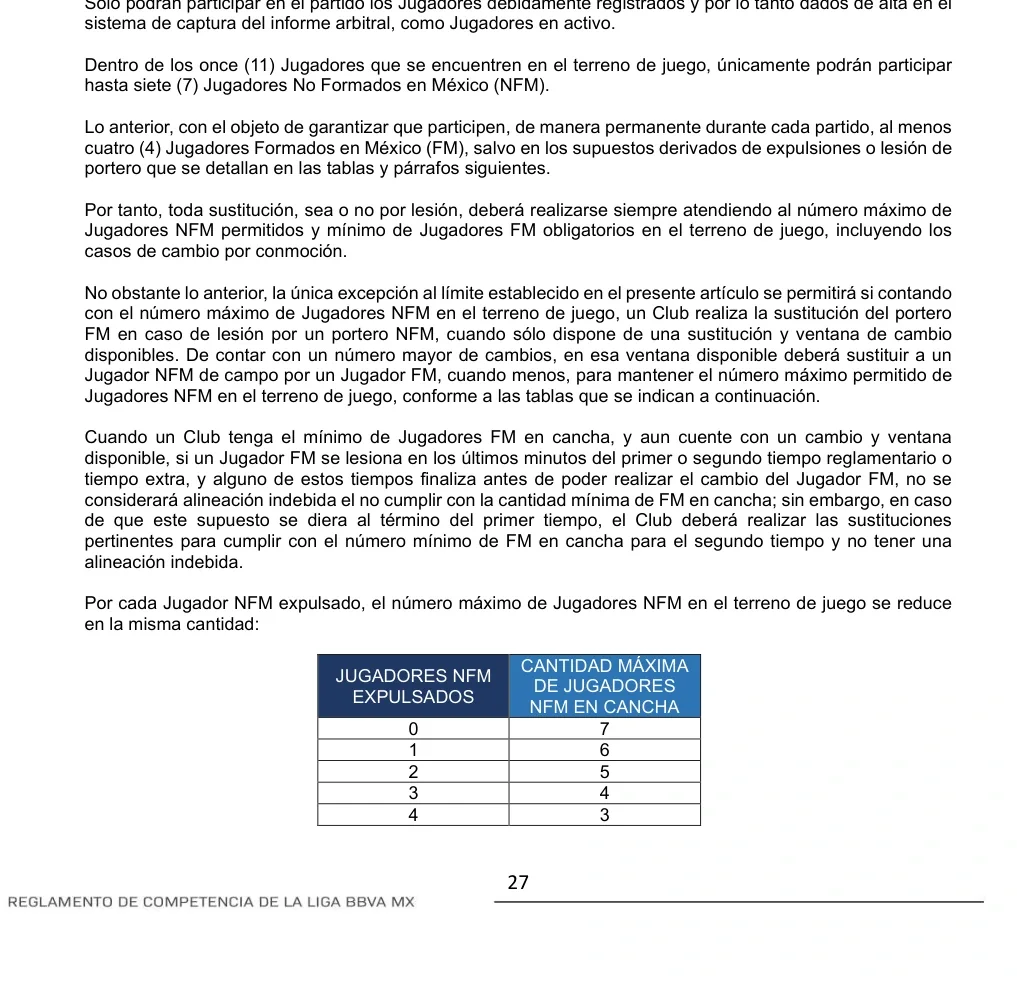
There is also a late-period injury provision. If an FM is injured when the team has the minimum FM number and still has a substitution and window, but the period ends before the change can be made, the temporary shortfall is not treated as an irregular lineup. If this occurs at halftime, the club must make the necessary changes for the second half. That limited situation should not be expanded into a general injury exemption.
Naturalization does not automatically remove an NFM place
A naturalization announcement does not immediately free a club's NFM slot. The registration appendix separates updating a player's nationality from changing his league classification, and it specifies when the relevant updates can occur. That distinction is essential when evaluating a club's recruitment plans or a claim that its quota has suddenly expanded.
Updating nationality and changing classification are separate steps
Under appendix article 8, a player who obtains his naturalization letter during a tournament must wait until the next registration period to update his nationality in the league record. The same paragraph expressly says his NFM classification does not change merely through that update. Reading only the nationality announcement misses the part that matters to the quota.
The appendix then supplies a specific route to possible FM classification. A player who obtains his naturalization letter, is called into Mexico's senior national team and participates in an official tournament or competition may be considered FM in the following registration period. A call-up alone is not the participation condition, and a friendly should not be substituted for the stated official-competition requirement.
The timing also matters. Even where the qualifying conditions are fulfilled, the provision points to the following registration period, not an instant change during the tournament. The club must provide the registration authority with the required original or certified naturalization document. Supporters should look for the completed league update before declaring that a place has been released for another signing.
Mexico eligibility and Liga MX registration answer different questions
FIFA's international eligibility framework decides whether a player can represent a national association. Liga MX's registration rules decide how he is classified within the domestic competition. FIFA's updated September 2026 guidance emphasizes that, where a genuine link is required, nationality alone is insufficient without an objectively identifiable connection through birth, descent or residence. Neither framework should be reduced to “he has a passport now.”
There is also a selection decision. A footballer can meet international eligibility conditions without being chosen by Mexico's coach, and domestic classification does not guarantee an international debut. Those distinctions protect supporters from treating interest in a player, an application, nationality, FIFA eligibility and an official appearance as if they were a single completed event.
For a practical check before the next league round, establish four things separately: the player's registered category, whether any nationality update is complete, whether the specific route to reclassification has been fulfilled and when the next permitted registration change takes effect. An unverified future national-team appearance cannot be counted as a current extra NFM place.
Finally, NFM is a competition classification, not a judgment that a naturalized citizen is less Mexican. The football question is which registration provision applies and whether the club has completed it. Keeping that administrative question precise makes the quota easier to understand without turning it into a claim about somebody's national identity.
Comments
Comments are reviewed before publication.
Sign in with Google to comment. Spam, abusive content, personal information and policy-violating links are not published.
Sign in with Google to comment or reply.
Loading comments…