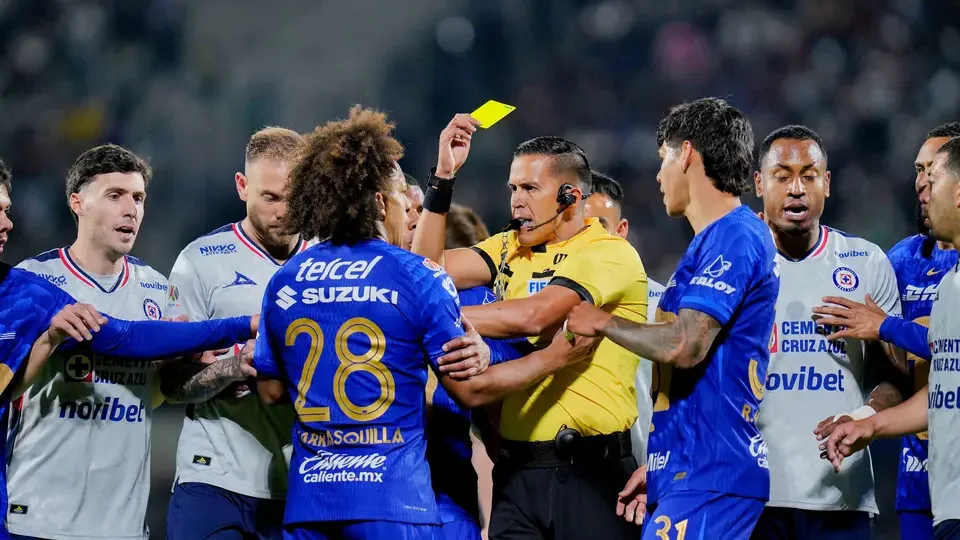
Liga MX yellow-card totals are cancelled when the regular phase ends so qualifying players start the Liguilla with a fresh caution balance. An already earned suspension still has to be served. That distinction answers the most important final-week question: a fifth yellow does not become harmless simply because the next match belongs to the playoffs.
This explanation follows article 15 of the FMF's 2026/27 sanctions regulations, checked on October 29, 2026. It explains the rule and its practical examples rather than presenting an old list of players on four yellows as today's availability report. The Liguilla is Liga MX's championship playoff phase.
Yellow-card totals reset, but an earned suspension survives
The reset removes the caution balance used to calculate future accumulation; it does not cancel a suspension that the player has already triggered. Article 15 makes both points. It provides for qualifying clubs to begin the final phase without accumulated cautions, then expressly requires players who reach a suspension threshold to serve the sanction even if the next match is in another phase, tournament or season.
Think of the balance and the ban as two separate pieces of information. The balance answers how close a player is to the next accumulation threshold. The ban answers whether he must miss a match because a threshold was already reached. A clean balance on a new-phase graphic can coexist with an outstanding match suspension. That is why “the cards are wiped” is an incomplete availability answer.
Four yellows and a fifth yellow lead to different outcomes
Take a hypothetical player who finishes the regular phase with four counted yellows and no other suspension. He has not reached the first five-card threshold. When his club enters the final phase, those four cautions are cancelled for accumulation purposes. His first counted Liguilla caution starts the new balance; it is not the fifth caution in the old regular-phase series.
Now change one fact. The same player receives a fifth counted caution in the last regular-phase match. That reaches the first threshold and produces a one-match suspension. If his next eligible competition fixture is the opening playoff match, crossing into the Liguilla does not erase the obligation to serve it. These examples concern ordinary accumulation; a separate dismissal or other disciplinary decision would also have to be checked.
This difference can materially affect a two-leg tie. A coach planning the opening match needs to know who is actually available, rather than assuming every player benefits equally from a reset. The Liguilla guide explains the playoff structure, but the disciplinary decision determines whether a particular footballer can take part in the relevant leg.
It is also why a broadcast mentioning a player's fourth yellow should not be paraphrased as a current suspension. Four is a warning position under the first accumulation cycle; five is the threshold. Conversely, a website showing zero cautions after a phase transition should not override an official notice stating that a match ban remains unserved. Read both pieces of information together before treating a predicted starting eleven as confirmed.
How the five-yellow accumulation rule works
The first suspension threshold is five counted cautions. Article 15 then increases the sanction at successive groups of five within the applicable accumulation period. Serving the first suspension is not the same as cancelling the entire caution record midway through the regular phase. The new-phase cancellation is a separate rule with its own timing.
Five, ten and fifteen cautions carry escalating penalties
The first five cautions produce a one-match suspension and a fine of 200 UMAs. Reaching ten produces a two-match suspension and a 300-UMA fine; reaching fifteen produces three matches and 400 UMAs. The rule continues the escalation for additional groups of five. These are disciplinary thresholds, rather than a prediction that a particular player will reach such a total.
| Counted cautions | Match suspension at threshold | Fine |
|---|---|---|
| 5 | 1 match | 200 UMAs |
| 10 | 2 matches | 300 UMAs |
| 15 | 3 matches | 400 UMAs |
UMA is Mexico's official unit used for calculating specified monetary obligations. A fine expressed in UMAs is not a dollar figure and should not be converted using an arbitrary exchange rate or an outdated unit value. For supporters planning a match, the football consequence is the number of fixtures the player must miss; paying the financial penalty does not itself make that suspension disappear.
The Liguilla is not a three-yellow competition under this rule
The current article expressly covers an official tournament or final phase and says final-phase cautions are accumulated under the same article. It does not introduce a three-yellow playoff threshold. A short online explainer claiming that three Liguilla bookings automatically mean a suspension should therefore not replace the current FMF wording.
A fresh balance does not mean unlimited freedom for the entire playoffs. For example, a hypothetical player booked once in each quarterfinal and semifinal leg would have four counted playoff cautions. A fifth in the final's first leg would reach the first suspension threshold and could rule him out of the return leg. Article 15 provides no automatic amnesty between those final matches simply because missing the decider would be costly.

Remember that the two legs of a tie are separate matches. A booking in the first leg remains relevant to the running playoff balance when the return match begins. Use the current fixture schedule to identify the next match, and the relevant report to establish the player's disciplinary position.
Two yellows in one match are treated as an indirect red
A second caution in the same match produces an indirect red: the dismissal results from the pair of yellows. A direct red instead punishes an offence serious enough to merit dismissal on its own. The distinction matters after the match because the accumulation rule specifically addresses the two cautions forming an indirect-red suspension.
Article 14 provides an automatic suspension for the next match following a two-caution dismissal during the match, including extra time. The fact that the referee first displayed yellow rather than a straight red does not make the player available for the next fixture. Any additional misconduct or subsequent decision must also be considered when reading the complete sanction.
Do both cautions also increase the five-yellow total?
No. Article 15 excludes the yellows imposed in the same match that form the indirect-red suspension from the accumulated-card calculation. Do not count the pair again as two ordinary cautions toward the five-yellow threshold. The dismissal has its own disciplinary consequence; excluding those two cards from the accumulation balance does not erase the red-card ban.
For a hypothetical example, a player enters a match with four counted cautions, then receives two yellows and is sent off. Under the pair-exclusion provision, those two match cautions do not turn the accumulation total into six. He still faces the suspension attached to his indirect red. The correct explanation identifies that dismissal rather than claiming he automatically owes separate five-yellow and red-card bans from the same pair.
A yellow followed by a direct red is a different sequence. The exclusion is written for cautions that form an indirect red, so it is unsafe to delete every earlier yellow merely because the player was later dismissed for something else. The official report's classification is more useful than the order of coloured icons in a highlights graphic.
The regulation also distinguishes ordinary cautions from the limited possibility of challenging a second caution that leads to dismissal. It describes the first yellow as definitive. That is not an invitation to assume any unpopular booking can be removed on request, nor does the existence of an appeal mean it succeeds. When a club challenges a decision, availability should follow the actual disciplinary outcome and applicable suspension, rather than the club's stated hope of recovering its player.
Which competition must a suspension be served in?
The ordinary rule is that a match suspension is served in the same competition. A phase change within Liga MX is different from playing in a separate cup or a friendly. Article 10 governs execution of suspensions, while article 15 separately says caution accumulation is calculated by competition. Supporters need both rules when a club has several types of fixture on its calendar.
Separate competitions do not share a single yellow-card balance
A player with four counted Liga MX cautions does not reach five simply because he is booked in another competition. Those balances are separate. Equally, a club should not treat a friendly as the game in which a league accumulation suspension is served. The date of the next football match is less important than whether it is the relevant competition fixture.
There are exceptions to the ordinary execution rule. For serious cases, the Disciplinary Commission can determine the competition in which a sanction must be served and its scope. Article 10 generally treats sanctions of four or more matches as serious, while allowing the commission to assess other cases. That prevents a blanket claim that every kind of ban is always isolated within one competition.
This distinction is especially useful when a player has several disciplinary records at once. A competition-specific caution balance, a suspension already triggered and a broader serious-misconduct decision are not interchangeable. A report saying that the player is clear of a Liga MX accumulation ban does not, by itself, settle every other possible eligibility issue.
A new tournament does not erase an outstanding ban
Article 15 also cancels caution balances at the end of each tournament so players can start the next tournament or season without accumulated yellows. Its carryover provision still requires an earned suspension to be served. A club eliminated before its player can complete a ban cannot assume the summer or winter interval has done the job instead.
The execution rules count qualifying matches actually played; they do not measure a suspension by the number of weekends that pass. A postponed fixture is therefore not automatically a served match. Article 10 also addresses interrupted matches and circumstances in which the commission must decide whether a fixture counts. Check the actual sequence of completed fixtures rather than counting dates on an old schedule.
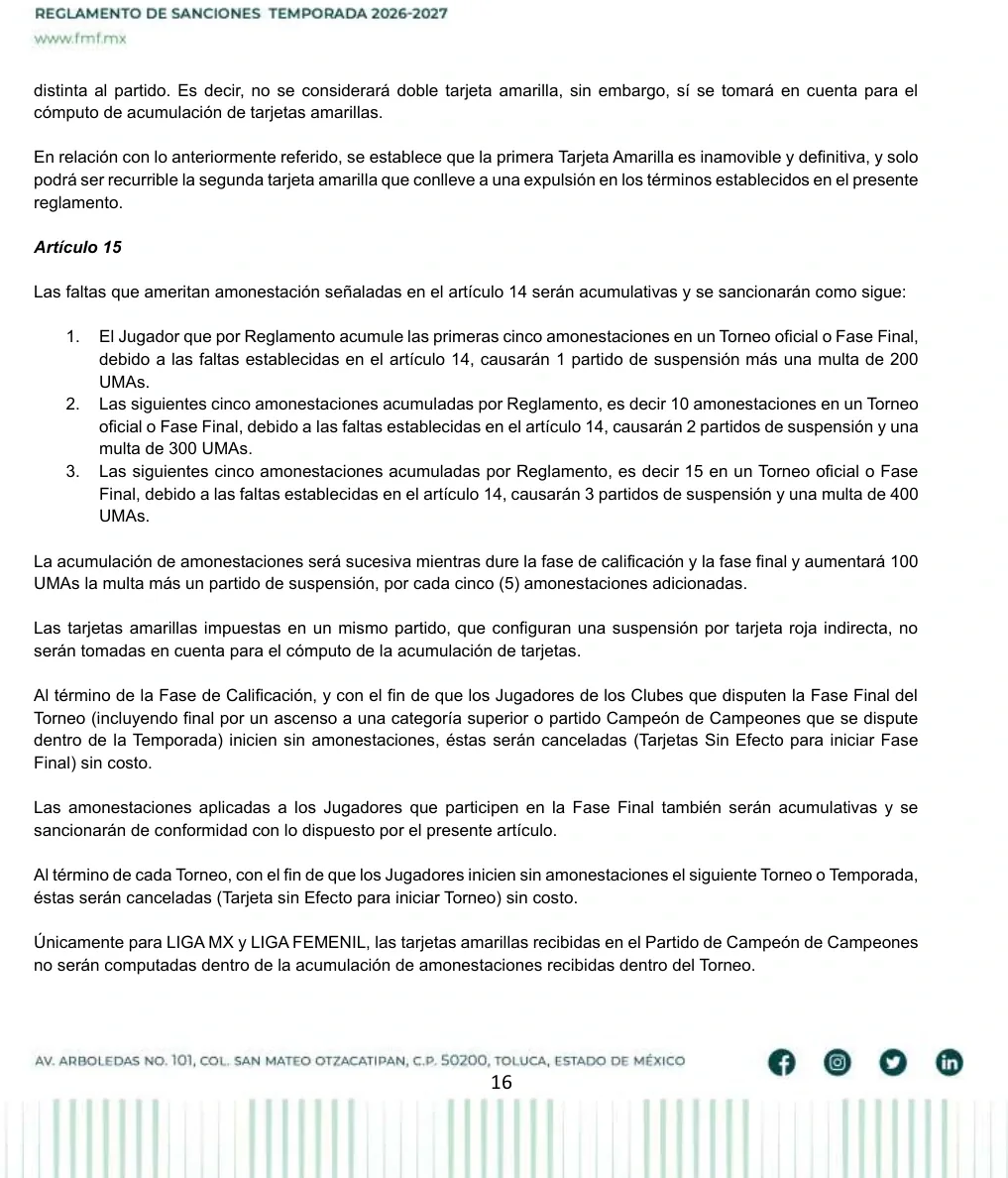
There is a specific Liga MX provision for Campeon de Campeones: its yellows do not enter the tournament's ordinary accumulation balance. That does not make all disciplinary consequences of that match disappear. Article 10 separately provides for sanctions imposed there to be served in the next applicable official fixture, even in another season. Always distinguish which record a particular exception changes.
The playoff schedule and format can identify the relevant leg, but the official sanction and its execution conditions determine whether the player has completed the ban. A transfer, registration change or new competition label should not be treated as an automatic escape from an unserved penalty.
How to check a player’s availability before a playoff match
Check the relevant official disciplinary information, the type of sanction and the matches already served. A cards column alone cannot answer all three questions. This matters particularly after the last regular-phase round, when a reset can make the balance look clear while an earned suspension remains outstanding. It also matters after a club has announced an appeal but before the outcome is known.
Read the decision, not just the cards column
Start by matching the report to the correct competition and tournament. Liga MX, Expansion MX and youth-category reports can appear close together on the federation's news pages. A familiar club name or the same round number does not make the reports interchangeable. Then check the player's full name rather than relying on an abbreviated surname or an account reposting a cropped image.
- Identify the competition, report date, match and player.
- Read the stated cause: accumulation, indirect red, direct red or another sanction.
- Check the suspension length and any stated conditions or competition scope.
- Count the applicable completed matches served since the sanction took effect.
- Look for a subsequent official decision correcting or changing the position.
Apply the rule to the actual sequence. Four counted cautions at the regular-phase finish, without another sanction, lead to a different answer from a fifth counted caution in that last match. Two yellows forming a dismissal are another route again. If a report's explanation and a public statistics table disagree, establish whether one is counting raw cautions while the other applies the indirect-red exclusion or a phase reset.
An appeal request is also different from a successful appeal. As a dated example, Mediotiempo reported on October 27 that Monterrey had failed in its request to remove the red cards involving Orbelin Pineda and Matias Almeyda. That report illustrates why “the club is appealing” is insufficient information for a lineup decision. It does not supply a general rule that appeals always fail, or justify inventing the detailed reasoning in another case.
Do not reverse the mistake by assuming that a player is automatically clear whenever the newest report is not yet visible. Article 6 gives automatic cautions, dismissals and match suspensions immediate effect for the subsequent relevant fixtures even before notification. Publication timing is therefore not permission to field somebody who has automatically triggered a ban. Clubs must track the underlying record, not merely wait for a website update.
Before watching today's Liga MX matches, distinguish a disciplinary absence from an injury, rotation or an unconfirmed predicted lineup. For a playoff preview, the useful wording is match-specific: what sanction exists, whether it has been served and what remains unresolved. That gives supporters an answer they can use without turning an old four-yellow watchlist into a false claim about who will start tonight.
Comments
Comments are reviewed before publication.
Sign in with Google to comment. Spam, abusive content, personal information and policy-violating links are not published.
Sign in with Google to comment or reply.
Loading comments…