
Liga MX clubs must accumulate at least 1,170 qualifying youth-player minutes during the regular phase of each tournament. Only 225 can count from any one match. That combination explains why the youth-minutes table suddenly becomes important alongside goals, wins and the race for the Liguilla, the championship playoffs.
This guide explains the 2026/27 competition rule as checked on October 29, 2026. October reports identified several clubs still below the target, but a published deficit is a dated position, not proof that a deduction has already been imposed. The useful questions are which players qualify, how appearances are credited and how much room a club has left to complete the requirement.
Why the youth-minutes rule matters in the Apertura run-in
A club can have enough points to occupy a playoff position and still have unfinished work under the youth rule. Article 49 of the 2026/27 competition regulations sets a separate participation obligation. Supporters therefore need to follow two different totals: the team's sporting points and its credited minutes from eligible young players. Success in one does not automatically satisfy the other.
The issue became prominent during October's run-in because several contenders were still below the threshold in published reports. On October 28, Excelsior reported Monterrey on 784 credited minutes, leaving 386 to reach 1,170, with a match outstanding. That is a useful dated illustration of the problem. It is not a certified live balance for Rayados on every subsequent matchday, and it should never be presented as an already imposed penalty.
Uneven fixture lists complicate comparisons. A postponed league match can leave a team with fewer opportunities used than a rival listed immediately above it. A headline saying that a club is near the bottom of the youth table does not tell the whole story without matches played, remaining league fixtures and the date of the tally. Check the ordinary Liga MX standings alongside the youth figures rather than treating either list as a complete account of the club's position.
A reported deficit is a warning, not a points deduction
Being short before the regular phase finishes means the club still has an obligation to complete. It does not mean every match played while below 1,170 is an offence that triggers another deduction. The distinction matters when social posts describe a team as “losing three points” even though the available evidence shows only minutes still to be earned.
The sporting danger is conditional but real. If a club ultimately fails, a points adjustment can change its place relative to rivals. Whether that costs qualification or merely changes its seed depends on the final table and the other results. It is misleading to turn a deficit headline into a definite prediction that a named club will miss the playoffs.
The rule also measures participation rather than a complete development programme. Reaching the total does not establish that a youngster has secured a long-term starting place; finishing below it would not by itself explain every problem in an academy. For supporters judging a coach's selections, the productive question is how eligible players are being integrated into meaningful match roles while the team meets a clear competition requirement.
Which players and appearances count toward 1,170 minutes?
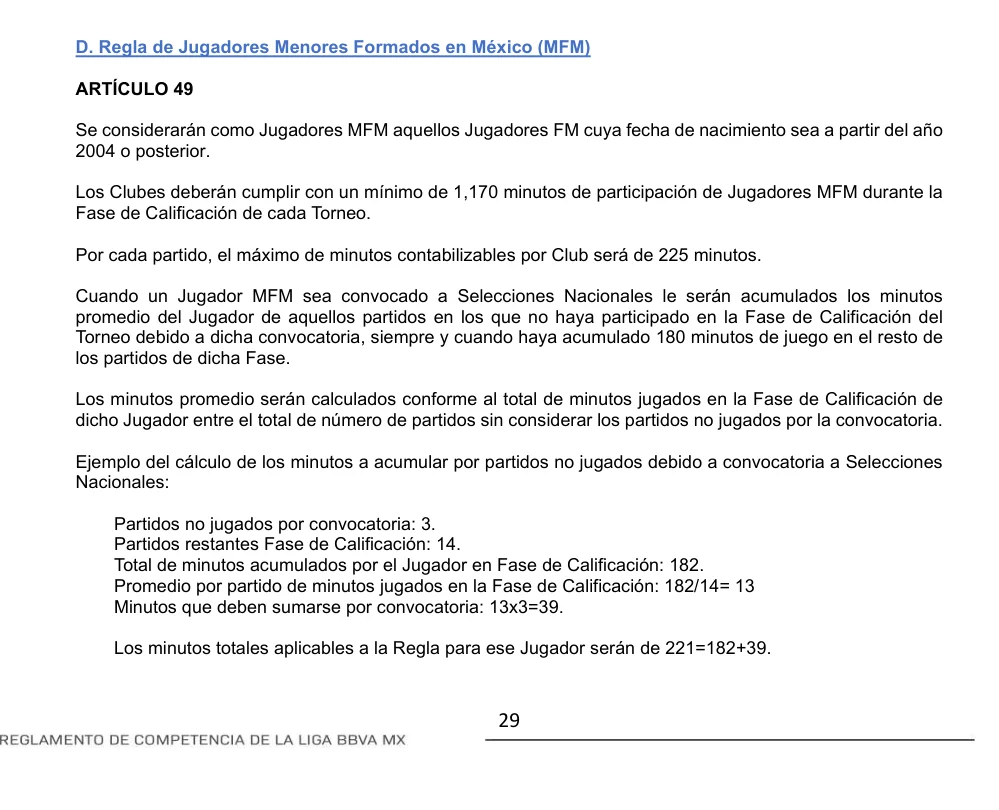
The player must satisfy both the current FM classification and the rule's birth-year threshold. Article 49 calls this group MFM, short for Menores Formados en Mexico, or young players classified as Mexican-trained. For 2026/27, it covers qualifying FM players born in 2004 or later. A young footballer does not automatically generate qualifying minutes simply because a television graphic calls him an under-23 prospect.
Birth year and Mexican-trained status both matter
Read FM as the league's defined registration category. Article 46 of the current competition regulations describes FM players as those born in Mexico or with a Mexican father and/or mother who, at registration, have a passport and birth certificate issued by the Mexican authorities. NFM is the category for players who do not meet that definition. The label should not be replaced by a guess about where somebody learned to play.
This is an important protection against two common shortcuts. Being young is one test, and holding a particular nationality is not by itself a complete reading of the registration rule. Before assigning minutes to an unfamiliar substitute, establish the player's current league classification and birth year. A social-media flag beside his name is not an official eligibility record.
Older explanations can also describe different birth years or percentage weights for different age groups. Those details belong to the regulation being discussed at the time. Current article 49 states the 2004-or-later threshold and the club's match ceiling; supporters should not import an old multiplier into a new tournament's calculation. A birthday during the season is not a reason to substitute a rolling age test for the stated birth-year condition.

The target belongs to the regular phase of each tournament
The obligation is 1,170 minutes during the Fase de Calificacion, the league's regular phase, of each tournament. Apertura and Clausura are separate competitions for this purpose. Surplus minutes from a previous tournament are not a savings account a club can spend when its younger players receive fewer opportunities in the next one.
Actual participation matters. Naming an eligible player among the substitutes without bringing him on does not create playing minutes. Equally, an academy fixture or a match in another competition should not be dropped into the senior league total merely because the player wore the same club badge. The relevant appearance must fit the rule's competition and phase.
That deadline is why the remaining league schedule matters to coaches. A potential Liguilla run cannot be treated as extra time to repair the regular-phase requirement. Teams need an eligible-player plan within their remaining qualifying matches, allowing for fitness, selection and the possibility that a planned substitute never gets on.
How the 225-minute match ceiling changes the calculation
The 225-minute ceiling applies to the club's combined qualifying contribution from a match, rather than to each youngster separately. Several eligible players can build the total together, but the team cannot keep adding unlimited credit by filling the lineup with them. That is why a large deficit can require opportunities across more than one fixture even when enough young players are available.
Why playing several youngsters cannot erase any deficit in one night
Consider a simplified hypothetical match calculation using 90 minutes per full appearance. Two eligible players completing 90 minutes each produce 180 player-minutes, below the club ceiling. Three completing 90 each produce 270 raw player-minutes, but only 225 can be credited from that match. The extra 45 do not turn the fixture into a 270-minute contribution toward the requirement.
The distinction is between time played by individuals and the amount credited to the club under this particular rule. The players have still received their appearances; the competition has placed a limit on how much one match contributes to compliance. A graphic adding every youngster's playing time without applying the ceiling can therefore overstate the club's progress.
There is also a useful tournament-wide check. Five matches at the ordinary maximum produce 1,125 minutes, still 45 short of 1,170. Without a separate qualifying national-team credit, a club needs contributions from at least six matches to complete the requirement. This arithmetic explains why planning regular opportunities is more reliable than expecting a single youth-heavy lineup to settle everything late in the tournament.
Work backward from the matches that actually remain
Suppose a hypothetical club needs 300 minutes and has two qualifying matches left. It needs an average of 150 per fixture. If it earns the full 225 in the first, it still needs 75 in the second. These are planning numbers, not promises about how many youngsters the coach must start or the precise time at which a substitution will happen.
Now suppose the same club instead needs 500, again with only two fixtures remaining. Those matches can supply at most 450 ordinary match credits. Before calling its position impossible, check whether any valid national-team credits remain to be recognized. Without such an additional qualifying contribution, however, ordinary appearances in those two matches cannot close a 500-minute gap.
Selection carries practical risk even when the arithmetic fits. An injury, dismissal or match situation can interrupt a planned appearance. A substitute expected to play the last half-hour may never enter. Supporters can assess the available margin, but they should avoid claiming a coach has guaranteed compliance merely because eligible names appear on the teamsheet.
How national-team call-ups can add credited minutes
A qualifying national-team absence can generate additional credited minutes, but the rule does not simply award 90 for every club match missed. Article 49 uses the player's average participation in the regular phase and includes a minimum-playing-time condition. This is the detail most likely to make a straightforward sum of club appearances differ from the final compliance calculation.
The 180-minute condition and average-minute calculation
Under the ordinary provision, the eligible player must accumulate 180 minutes in the other regular-phase matches. His average is calculated using his total minutes played divided by the number of regular-phase matches excluding those missed because of the call-up. That denominator is important: it is not simply the number of games in which he happened to appear. Otherwise a player with occasional appearances could receive a substantially inflated average.
The regulations provide a clean worked example. A player misses three club matches because of national-team duty and accumulates 182 minutes over the other 14 fixtures. Dividing 182 by 14 gives an average of 13 minutes. Multiplying 13 by the three missed matches adds 39 credited minutes. His contribution for the youth rule becomes 221: the 182 actually played plus the 39 credited for the qualifying absence.
Notice how different that is from adding three full matches. The credit compensates the club according to the player's regular involvement; it does not assume he would have started and completed every fixture. It also does not mean his minutes in an international match are transferred directly into the Liga MX total. A full appearance for a national team and the calculation of his club's youth credit are different records.
There is a specific injury exception to the ordinary 180-minute condition. If the player is injured during the call-up and that injury prevents him from continuing in the tournament, the Medical Commission must determine that the injury occurred during that period and warrants his withdrawal from the competition. In that case, the regulation provides for average-minute credit over the remaining regular-phase rounds. This is not a blanket exemption for every injured youngster.
When a club explains that its visible deficit will be covered by call-up credits, look for three things: which eligible player was away, which league fixtures he missed for that reason and whether the applicable conditions have been met. The league fixture list supplies context, but only the recognized calculation settles the credit. A call-up announcement alone is insufficient to certify the final total.
What happens if a club finishes below the requirement?
Failure brings a three-point reduction and a separate financial consequence under article 49. Those sanctions make the requirement relevant even to supporters primarily concerned with winning the next game. Completing the minutes is part of competing under the tournament's rules; points collected on the field do not purchase an exemption.
Three points and a separate development-income penalty
The regulation specifies a reduction of three points in the general classification and coefficient tables. In a hypothetical example, a club with 30 sporting points would have 27 after a three-point adjustment. Its resulting place would still depend on the other clubs' totals and applicable ranking rules. It would be wrong to declare automatic elimination without doing that comparison.
The financial measure is a 15 percent reduction in resources delivered through Derechos de Formacion, or training rights. This is a defined development-related income stream, not a statement that the club loses 15 percent of all revenue, broadcasting money or ticket sales. Reports sometimes compress the consequence into the word “fine,” but the rule's specific wording is more useful than an invented cash amount.
The two measures sit together. Nothing in this provision gives the club a choice to pay money instead of accepting the points consequence. Nor should supporters confuse the adjustment with changing every match result involving that team. A standings penalty can alter the Liguilla picture while leaving the recorded scores as the scores played.
A useful final-week checklist for supporters
Before sharing a claim that a club has failed the rule, identify the date and basis of the figure. A table circulated before a postponed match may already be out of date. A sum of visible appearances may exclude valid call-up credits. A list of promising academy players may include someone outside the eligible birth years or registration category.
- Check the season's birth-year threshold and each contributing player's FM classification.
- Use the credited match totals, applying the 225-minute club ceiling.
- Separate actual league minutes from any conditional national-team credit.
- Count the club's remaining qualifying fixtures, including outstanding matches.
- Distinguish a projected shortfall from the final recognized total and any official sanction.
These checks make the debate more precise without reducing young players to arithmetic. Fans can still ask whether prospects are receiving sustained opportunities, appropriate positions and a path into the first team. The compliance question has a narrower answer: did the club reach the required credited total within the regular phase? Keeping that question separate allows supporters to discuss both the immediate playoff stakes and the quality of the opportunities their youngsters actually receive.
Comments
Comments are reviewed before publication.
Sign in with Google to comment. Spam, abusive content, personal information and policy-violating links are not published.
Sign in with Google to comment or reply.
Loading comments…