Watching Liga MX in Mexico often means following the home club's television deal rather than following one league-wide streaming subscription. A service can carry a large part of the competition and still miss the particular away match you want. The app works, your payment is active, and the football may legitimately be somewhere else.
That is the practical problem behind the complaints about scattered rights: supporters have to work out which match is included before deciding whether another subscription is worth buying. This guide is for people watching in Mexico, using provider information checked on October 29, 2026. It explains home and away rights, territorial differences and paid add-ons, then shows how to compare your next fixtures without assuming that every fan needs every service.
Why does Liga MX move between services in Mexico?
The competition's home-match rights are distributed across different television and streaming agreements. Buying access to one provider does not combine all the other providers' packages. For a supporter, the result is a changing route to the match: the club is familiar, but the service carrying its next appearance can depend on the opponent and who is hosting.
The frustration has a documented basis. In its September 18 report, La Jornada described the retreat from free-to-air coverage and reported that fewer than half of the first 70 Apertura matches had been available that way. That is a dated early-season sample, rather than a measurement of the entire tournament. It helps explain why a supporter accustomed to finding football on an open channel may now face a purchase decision.
The home fixture is the starting point for the TV search
Start with the home side on the Liga MX fixture list, then look for the current Mexico-specific transmission notice. Searching only for your favorite club can return last week's game, a US listing or a general package advertisement. A home-rights agreement is a useful guide to where to look, but the current match listing tells you whether the specific encounter is on an open channel, a paid channel, a streaming service or more than one of those routes.
Your viewing goal matters as much as the provider list. Following one club's remaining fixtures is a smaller problem than watching every match in the league. The service needed for an away game may already be included in a television package you own; another fixture might be available on an open channel. A headline about how many subscriptions are needed for every sport in Mexico does not establish how many you need for your own club this month.
A missing game should therefore prompt a rights check before a second purchase or a complaint about an outage. Verify that the provider actually lists the match for Mexico. If it does, your account access becomes the next question. If it does not, reinstalling an app cannot supply a broadcasting right that the app does not hold. Separating those questions gives customer support a specific problem to answer and makes your subscription decision easier to assess.
Why can you watch your club at home but lose its next away game?
Your club's home agreement is not a season pass to every match it plays. When it travels, the host's package becomes the place to begin checking. That is why a paid service can remain useful for your club without being sufficient for its whole run-in. The same distinction applies to someone following the visiting side in a televised match: appearing on a service once does not transfer that club's other fixtures there.
Chivas on Prime Video is a home-rights example
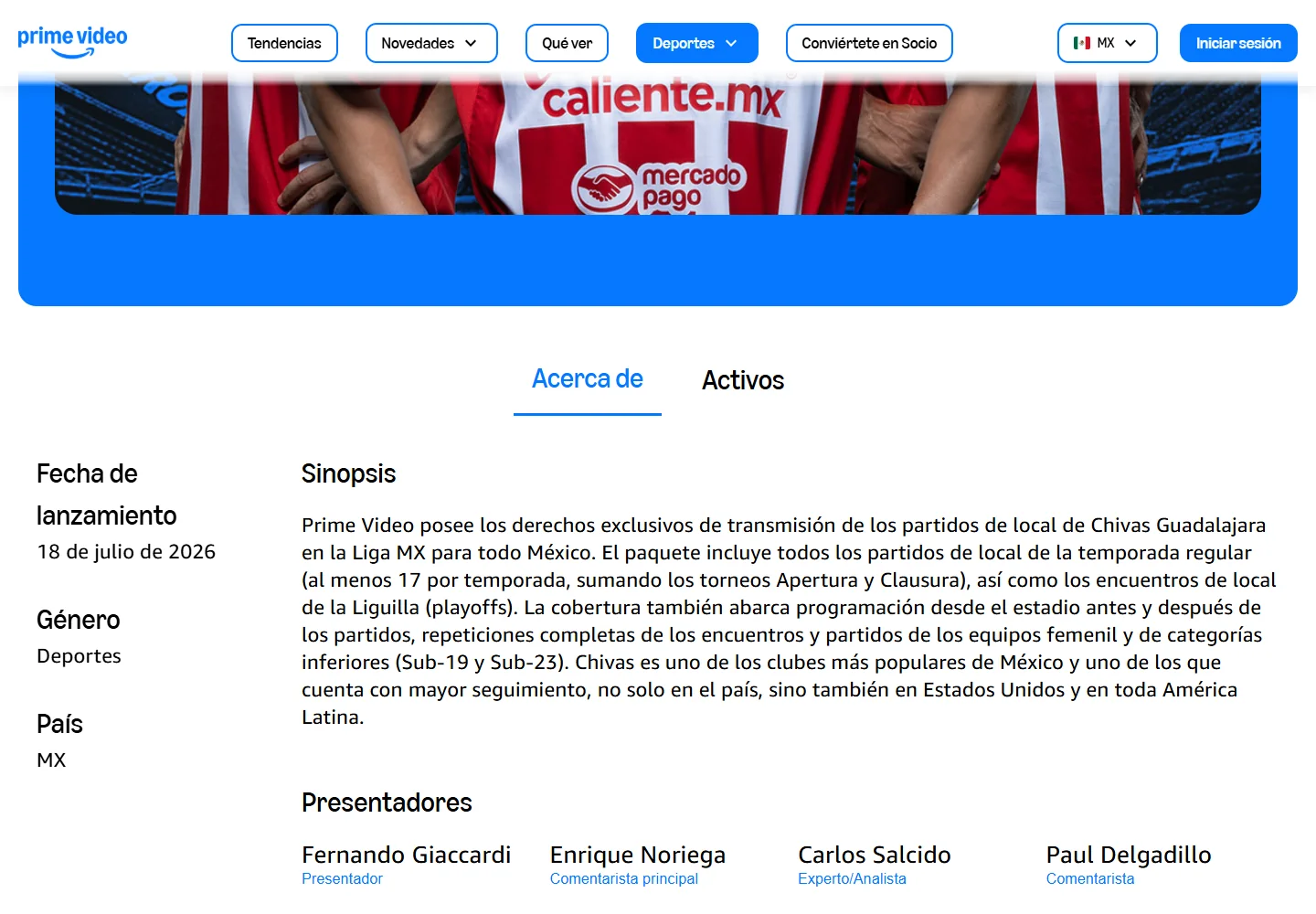
Amazon's official Mexico description defines its package as exclusive Chivas home Liga MX coverage in Mexico, including regular-season home fixtures and home games in the Liguilla, the championship playoffs. The key words are "home" and "Mexico." They establish a useful example without implying that Prime Video's base subscription carries every Liga MX game or every Chivas away appearance.
Imagine your next three fixtures are home, away and home. Start by identifying the two home games covered by the club's agreement, then investigate the away host separately. This is a planning example, not an announced run of Chivas fixtures. For the real sequence, use the current weekly schedule and the clubs' latest transmission notices. A saved provider list from another tournament can be useful background while still giving the wrong answer for a newly changed agreement.
A shared TV channel does not guarantee the same streaming access
Check the route you actually intend to use. A match shown on a television channel may also have a streaming option, but the channel's presence in a cable package does not by itself prove that every app carrying that brand includes the same game. Read the provider's event listing and your package entitlement. Likewise, an open-television announcement for one match is not a promise that every subsequent home game will be available that way.
For a two-leg playoff tie, inspect each leg's host rather than assuming the first leg's service owns the whole tie. Amazon's stated Chivas package includes home Liguilla games; it does not turn an away leg into a Chivas home event. Keep the football format and the viewing agreement separate when making plans: advancing to another round can add fixtures you want to watch, while the host and the confirmed transmission notice still determine where each one is available.
Does seeing a match inside Prime Video mean it is included?
No. An app can display content that needs an additional purchase, and the event's presence in search results is not proof of access through your base membership. Check the access label on the actual match page and the terms of any offer it opens. A single interface can make several products look close together while keeping their subscriptions separate.
Base membership and paid channel subscriptions are separate purchases
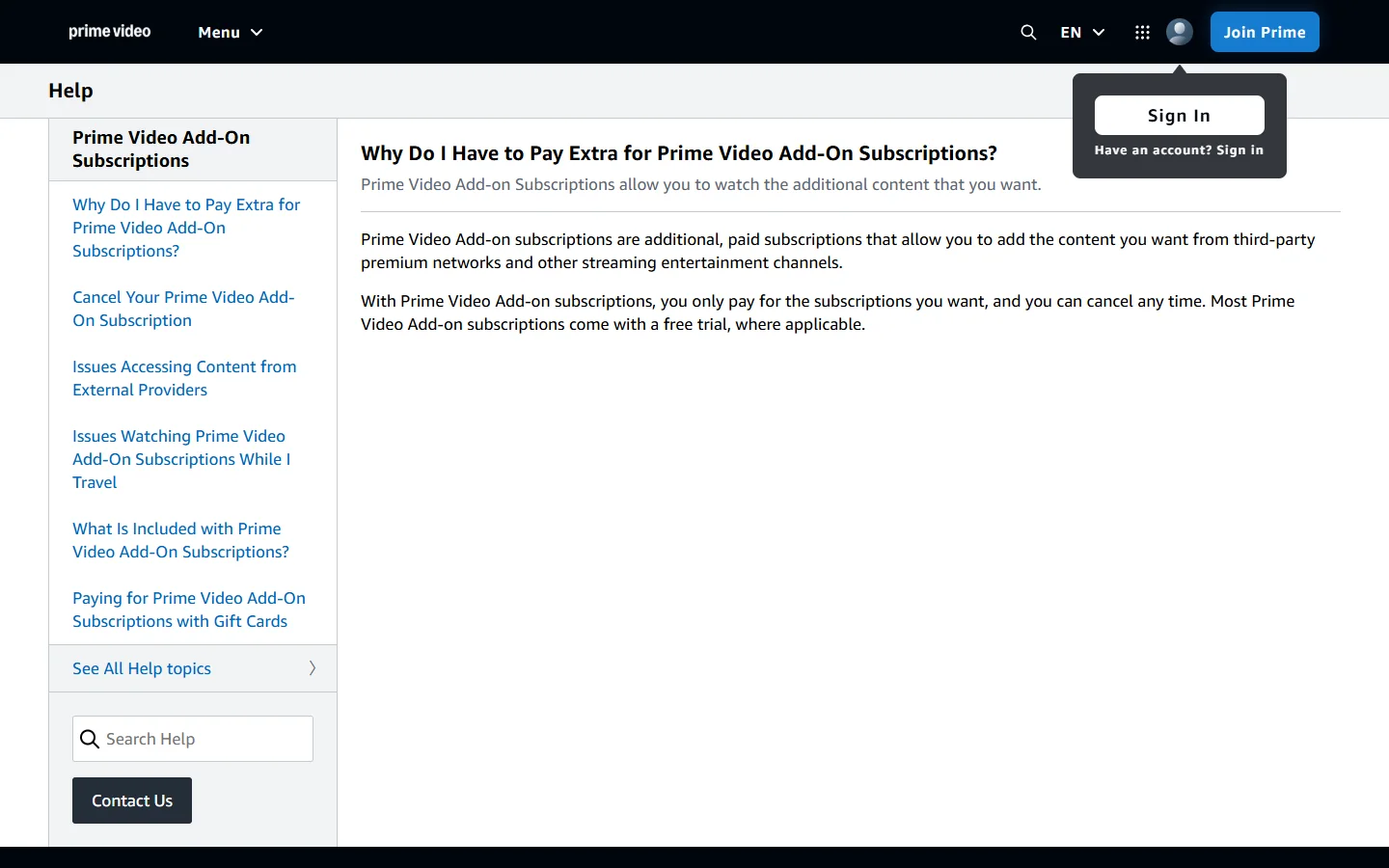
Amazon describes Prime Video add-ons as additional paid subscriptions for content from third-party networks and services. That distinction is separate from its own Chivas home-match agreement. If another Liga MX event is offered through a paid channel inside Prime Video, check that channel's offer rather than assuming your existing Prime payment already covers it.
Before confirming, read the product name, recurring charge, billing period and any trial end date shown to your account. The fact that two purchases appear under the same Amazon login does not make them one subscription. Keep the receipt or confirmation for the exact product you chose, especially if you are arranging access shortly before kickoff and need to ask support what was activated.
If you already subscribe directly to the provider, establish whether that existing account can be used through the route you are opening. Do not assume that paying directly automatically unlocks a separately sold channel inside another app. Ask the provider which sign-in and billing route applies before buying it again. This is a way to avoid duplicate purchases, not a claim that all services permit account linking or that every channel requires a second payment.
A promotional offer also needs its own check. Trials, discounts and eligibility can differ between accounts and purchase channels. Compare the charge that will apply after the promotion with the fixtures you actually want, rather than treating a headline introductory price as the cost of an entire tournament.
Why does a US viewing guide give a different answer?
Mexico and the United States are different broadcast markets. A guide can be accurate for a supporter in the US and still be the wrong purchasing guide for someone in Mexico. The familiar club, service logo and Spanish commentary do not erase the territory attached to the rights. Check where the viewer will physically be watching, rather than only the language of the website.
Match rights belong to a territory as well as a club
ViX's official schedule help tells viewers to check the Liga MX row in its Sports section and notes that a missing match may not be available in their region. That is a more useful entitlement check than assuming that an app available in both countries has an identical football catalogue in each one.
In a cross-border supporters' chat, ask which country a recommendation applies to before buying. "I watched our team there last week" leaves out both the host and the territory. Ask for the specific fixture and the provider's Mexico listing. When you travel, recheck the service's travel and territorial terms; do not assume your home purchase promises the same live sport everywhere you take the device.
Availability and account activation are different checks
A bundle can add another step. For example, Movistar's Mexican ViX terms describe activation and account creation before using the included service. That does not establish that every mobile or television package includes ViX, or that an old promotion still applies to you. Inspect your own package and the activation confirmation before purchasing a duplicate direct subscription.
If the match is listed for Mexico but access is denied, give support the fixture, product name, purchase channel and error message. If it is absent from the regional schedule, ask whether that encounter is licensed there. Those are different questions. Keep passwords and full payment details out of public fan posts; a screenshot of the relevant offer or error can usually describe the problem without exposing them.
How can you plan subscriptions without buying everything?
Build the purchase decision around the fixtures you intend to watch, then subtract the access you already own. A list of every platform in the Mexican market is not yet a useful shopping list. You need to identify the gap between your existing package and your chosen games, with enough time to activate any service before kickoff.
Compare the next fixtures with the subscriptions you already have
For each match, write down the host, date and confirmed Mexico broadcaster. Add the exact product that unlocks it, rather than only the company's name. Keep an "unconfirmed" entry where no current assignment is available. That is more honest and more useful than filling the gap with last season's provider. Use the fixture list to organize the matches, and the broadcaster or club notice to establish access.
- Which upcoming games do you actually plan to watch live?
- Which are home and which are away?
- Does an existing television, mobile or streaming package include the required product?
- Has that included benefit been activated on the account you will use?
- What recurring charge and renewal date does a new offer show?
- Where will you manage that subscription if you later decide not to renew?
Compare additional cost, not just sticker prices. If a service is already paid for and active, adding its full monthly price again exaggerates the cost of your football plan. If an advertised bundle requires another product you do not want, counting only its football component understates the purchase. Include the actual commitment shown to your account. This comparison can reveal a duplicate or an unnecessary purchase, but it does not guarantee that every fan can cover every game cheaply.
A billing month need not match a calendar month or the football round. Look at when access expires, when another charge is due and which company receives the cancellation request. Keep the confirmation if you change a subscription. Do not assume that deleting the app cancels billing, that canceling one service cancels an add-on elsewhere, or that a missed match automatically qualifies for a refund. Ask the seller about the applicable terms rather than relying on a fan's experience with another purchase route.
Finally, repeat the match check after a postponement, a venue change or a new playoff pairing. A spreadsheet of intended viewing is a plan, not a contract for future broadcasts. Confirm the actual listing close to matchday so a sensible subscription choice does not rest on an assignment that was never announced.
Will the reported 2028 rights plan put every game in one app?
The recent reports do not establish a confirmed single-app subscription for supporters. A possible move toward selling rights together is a development to follow, but it does not change the package you need for this week's match or announce what a future customer will pay.
Central selling and a single consumer subscription are different decisions
On October 22, El Informador reported a possible 2028 horizon, attributing the information to journalist David Medrano. Excelsior carried related conditional reporting a day earlier. The proposal involves clubs moving toward joint selling rather than extending individual arrangements beyond that horizon. The reporting describes a possibility and unresolved agreements, not a final retail offer available to buy.
Even if joint selling proceeds, a central seller could negotiate with one buyer or several. That is a different commercial decision from whether supporters receive all matches in one affordable subscription. Multiple packages, separate territories and different television and streaming routes remain possible outcomes; they should not be presented as either settled plans or problems already solved. What matters to a fan is the eventual access offered, not merely the identity of the organization negotiating.
The unanswered questions are concrete: which matches would be included, whether any remain on open television, which territories an offer covers, what the full recurring price is, and whether extra products are needed. A future announcement addressing those points would justify a new purchasing decision. A reported target year alone does not. There is no sound basis here to promise that your current subscriptions will merge automatically or that a particular provider has won the complete future league.
For now, follow the confirmed home fixture and the Mexico-specific transmission notice. That approach cannot remove the inconvenience of fragmented rights, but it can prevent a purchase based on an away-game assumption, a foreign listing or an extra channel mistaken for an included benefit.
Comments
Comments are reviewed before publication.
Sign in with Google to comment. Spam, abusive content, personal information and policy-violating links are not published.
Sign in with Google to comment or reply.
Loading comments…