
Which Liga MX teams are the most popular in 2026?
América has the strongest evidence-based claim to be Mexico’s most popular Liga MX club entering the 2026 season, with Chivas the clear national rival. Cruz Azul and Pumas form the next broad tier. That answer comes from the repeated order in recent national preference surveys—not from championships, transfer spending, or this month’s standings.
Two independent snapshots illustrate the pattern. Nielsen Sports México’s Fanbase 2024 results, as reported by Mediotiempo, placed América first at 24.7% and Chivas second at 19.2%, followed by Cruz Azul at 11.9% and Pumas at 11.1%. A separate set of national surveys reported by El Financiero in May 2025 also ordered those clubs América, Chivas, Cruz Azul, and Pumas, although its percentages were 34%, 21%, 17%, and 12%. Different samples create different point estimates; agreement on the order is the stronger takeaway.
América and Chivas form the clearest national top two
América leads both cited national measures, while Chivas remains the only club close enough to make the No. 1 debate a genuinely national rivalry. The distinction matters: a single poll can move after a championship, a losing streak, or a major signing, but the Águilas and the Rebaño Sagrado repeatedly occupy the first two places across years and methods. Their Clásico Nacional is therefore more than a contest between two successful teams; it joins the country’s two widest supporter networks.
This does not mean every Mexican region favors the same side or that every audience measure must put América first. Chivas’ identity—historically fielding Mexican players—creates a different emotional appeal from América’s glamorous, polarizing image. A fan may also dislike América intensely and still follow every result. That is attention, but it is not the same as support, which is why this guide does not add “most hated” votes to favorite-team percentages.
Cruz Azul and Pumas complete the traditional nationwide group
Cruz Azul and Pumas sit clearly behind the leading pair in the cited surveys, yet both remain national rather than purely local properties. La Máquina’s support reaches well beyond its current home ground, while Pumas connects the UNAM university identity to generations of families across Mexico. Their placement helps explain the enduring shorthand of the Cuatro Grandes—the “four big clubs” of América, Chivas, Cruz Azul, and Pumas. It is a cultural label, not an official league award.
Popularity should also stay separate from sporting merit. Toluca’s recent titles, Tigres’ modern trophy run, and Monterrey’s scale can make each club a stronger answer to a different question. Our best Liga MX teams guide uses professional-era league championships as its historical anchor. This article asks who commands attention and allegiance, so the evidence and order are deliberately different.
How we measure Liga MX popularity without inventing one perfect ranking
The fairest method is a dashboard, not a magic formula. Favorite-team surveys measure declared allegiance; attendance measures supporters who enter a stadium; social followers measure account reach; interactions measure response to content. Each answers a real fan question, but none represents every supporter on its own.
National surveys
Best for broad preference and the order of nationwide fan bases. Results depend on question wording, sample, geography, and fieldwork date.
Home attendance
Best for match-going demand in a particular tournament. Stadium capacity, venue changes, pricing, and local conditions shape the ceiling.
Social followers
Best for the scale of official accounts across platforms. One person can follow the same club in several places, so totals are not unique fans.
Digital interactions
Best for current conversation around posts. A viral signing or dramatic Liguilla can accelerate activity without creating lifelong allegiance.
Surveys measure preference, not every form of fandom
A well-described survey is the strongest tool here for the question “Which is your favorite club?” Nielsen’s reported 2024 study asked adults aged 18–65 in Mexican cities and produced a direct team-preference table. El Financiero described a separate set of 2,900 interviews with adults around the country; 1,560 of them named a favorite first-division team. Those frames are valuable, but they are not interchangeable. We cite each result as its own snapshot instead of averaging incompatible percentages.
Preference is also narrower than interest. Consulta Mitofsky publishes favorite-team sentiment, rejection, and a combined attention measure. América can lead affection and rejection simultaneously because opponents also care deeply about its results. Calling all that attention a “fanbase” would confuse supporters with rivals, so this guide uses favorite-team evidence for support and treats polarization as context.
Attendance, followers, and engagement answer different questions
A full stadium shows a powerful local relationship, but raw crowd size favors larger grounds. A cross-platform follower count shows enormous reach, but the same fan may follow a club on Instagram, TikTok, YouTube, Facebook, and X. Engagement goes one step further by counting reactions to posts, yet it moves with content volume, format, news cycles, and platform algorithms. These units cannot responsibly be added into one decimal-point score.
The practical reading rule is to ask what the metric proves. Use surveys to discuss nationwide preference, stadium averages to compare match-going scale within the same tournament, and digital measures to understand reach and conversation. Then use the Liga MX teams map to supply the local geography that a league-wide number misses.
What national fan surveys say about the leading clubs
The strongest survey conclusion is a tier, not a precise forever-ranking: América, Chivas, Cruz Azul, and Pumas command the broadest national preference, while the order immediately behind them is much less settled. Nielsen’s Fanbase 2024 snapshot offers the clearest complete table for comparing all 18 clubs under one question.
| Nielsen 2024 place | Club | Reported preference | How to read it |
|---|---|---|---|
| 1 | América | 24.7% | National leader in this snapshot |
| 2 | Chivas | 19.2% | Only close nationwide challenger |
| 3 | Cruz Azul | 11.9% | Strong third national base |
| 4 | Pumas | 11.1% | Nearly level with Cruz Azul |
| 5 | Tigres | 5.8% | Leading next-tier club here |
| 6 | Monterrey | 4.3% | Large regional power |
| 7 | Santos Laguna | 3.2% | Strong northern identity |
| 8 | Toluca | 3.1% | Historic, successful central club |
Source note: Nielsen Sports México Fanbase 2024 figures as reported by Mediotiempo. This is one dated favorite-team survey, not an official Liga MX ranking.
The Cuatro Grandes still dominate broad preference
The four traditional giants took 66.9% of preference in the Nielsen snapshot. An independent 2025 survey reported by El Financiero produced larger percentages and an 84% combined share, but the same top-four order. That repeated separation is why the phrase Cuatro Grandes remains useful in a popularity discussion even when fans dispute whether recent results or championship totals still justify the label.
Each club converts that breadth differently. Follow the current schedules for América, Guadalajara, Cruz Azul, or Pumas and the differences become visible: rivalry weeks, venue demand, and television attention can all surge without changing the underlying national order overnight.
Tigres, Monterrey, Toluca, and Santos lead the next conversation
There is no equally stable “fifth club.” Nielsen placed Tigres fifth and Monterrey sixth, reflecting the modern growth of the Clásico Regio powers, with Santos and Toluca next. Other surveys reorder that group or add Atlas. A championship can lift recall; a star signing can accelerate conversation; a regional sample can amplify the local giant. Those changes are signals, not errors.
The useful conclusion is that Tigres and Rayados combine substantial national visibility with extraordinary local scale, while Toluca and Santos carry championship history and strong regional identities. Calling one of them the undisputed fifth-biggest fanbase would demand evidence the available surveys do not provide. The next sections therefore test these clubs against attendance and digital reach instead of using one poll as the final word.
Which Liga MX clubs draw the biggest stadium crowds?
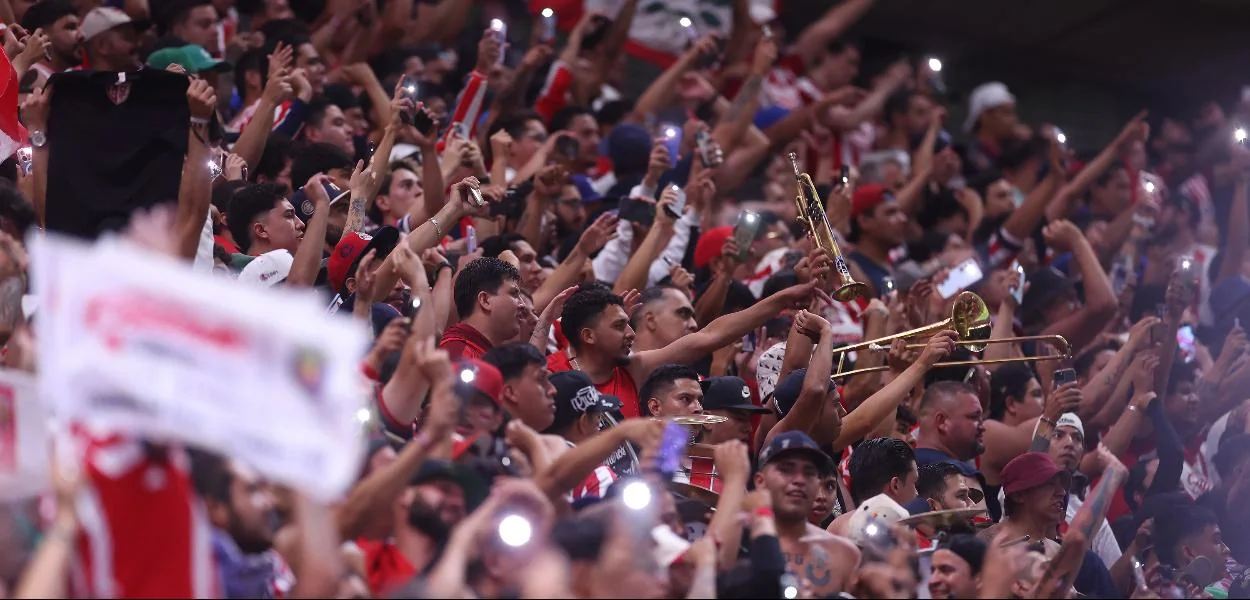
Monterrey, Tigres, and Chivas produced the three highest average home crowds in FotMob’s Clausura 2026 Liga MX table. Rayados led at 41,904, Tigres followed at 40,883, and Guadalajara averaged 39,283. This is the clearest match-going popularity measure in the guide—and a reminder that northern stadium culture can outperform the nationwide survey order.
| Clausura 2026 | Club | Average home attendance |
|---|---|---|
| 1 | Monterrey | 41,904 |
| 2 | Tigres | 40,883 |
| 3 | Chivas | 39,283 |
| 4 | Pumas | 32,471 |
| 5 | América | 28,249 |
Source: FotMob’s Clausura 2026 home-attendance table, accessed August 29, 2026. Figures are tournament averages, not estimates of total fanbase size.
Monterrey, Tigres, and Chivas led Clausura 2026 home averages
Rayados and Tigres turn the Clásico Regio divide into sustained demand on both sides of the Monterrey metropolitan area. The difference between their averages was barely more than a thousand spectators. Chivas’ official review independently recorded 347,130 regular-season attendees at Estadio Akron and an average near 39,000, which closely supports the provider table. The Rebaño also generated large road crowds, although a full away gate cannot be credited only to visiting Chivahermanos.
Capacity and venue context stop attendance from being a national ranking
Raw attendance rewards clubs with large available grounds. Estadio BBVA holds more than 53,000, while a smaller stadium can sell nearly every seat and still post a lower crowd. Temporary moves, renovations, security restrictions, ticket prices, kickoff times, and the number of included home matches also affect a tournament average. Occupancy rate answers a different question again: how fully a club uses the seats it can sell.
That context explains why América can lead national preference while finishing fifth in this one home-attendance snapshot. Match-going commitment in Nuevo León is unusually concentrated; nationwide support is geographically dispersed. Neither result cancels the other. Check the teams, cities, and stadium map before comparing gates, then treat the table as evidence of local matchday strength rather than a substitute for a national survey.
Which Liga MX teams have the strongest digital reach?
América leads Mexican clubs in the most useful comparable social snapshot, while Chivas sits a clear second. A June 2025 CIES Football Observatory analysis counted followers across Facebook, Instagram, TikTok, YouTube, and X. The reported totals placed América at 30.3 million and Chivas at 20.2 million—another top-two result, but this time for official-account reach rather than survey preference.
América leads the measured Mexican clubs by total followers
América
30.3m
Chivas
20.2m
Cruz Azul
8.6m
Tigres
8.2m
Pumas
7.4m
Monterrey
6.6m
CIES-based five-platform follower totals reported in June 2025. “m” means million platform follows; it does not mean unique individual supporters.
The order broadly resembles national preference, but Tigres’ narrow digital edge over Pumas is an example of the metric adding information rather than simply copying the poll. Modern sporting success, star players, short-form video, women’s-team content, and bilingual publishing can grow accounts. Platform audiences also cross borders instantly, making this measure especially relevant to fans who rarely enter a Mexican stadium.
Interactions reveal who drives conversation, not just account size
A 2025 digital report from El Míster and Emplifi counted activity on official club accounts from January through December. América generated 225.1 million interactions, Chivas 113.4 million, and Cruz Azul 91.3 million; Tigres ranked fourth. That order shows the Águilas did more than hold a large follower stock during the measurement window—their content also produced the most recorded responses.
Interactions still require restraint. A reaction may come from a rival, the same user can act many times, and a dramatic final can create a spike. Posting volume and platform strategy matter too. The clean conclusion is that América led both scale and activity in these cited datasets, Chivas remained a substantial second by reach, and Cruz Azul converted a smaller account base into notable conversation.
Digital momentum is easiest to understand when connected to matches. The Liga MX schedule this week shows the fixtures likely to drive the next wave of searches and clips. A rivalry or Liguilla night can change engagement immediately; it should not retroactively rewrite a national fan-preference survey.
Why popularity changes by region and across the U.S. border
Liga MX popularity changes with place because nationwide reach and local dominance are different strengths. América and Chivas travel across regions and generations; Monterrey and Tigres can own a city’s football rhythm; a club carried through a Mexican-American family can feel local in California or Texas even when its stadium is hundreds of miles across the border.
National clubs and regional powers can both be genuinely massive
El Financiero’s 2025 regional breakdown makes the contrast concrete. América reached 41% in the north in that survey, while Chivas led the center-west at 31%, ahead of América’s 27%. Cruz Azul was more popular than Chivas in the central region, and Pumas recorded its strongest regional result there. A national average smooths away these local contours.
Nuevo León adds a second model. Tigres and Rayados are bound to universities, neighborhoods, family inheritance, modern trophies, and the weekly argument of the Clásico Regio. Their stadium averages show how deeply that two-club contest structures matchday life. A club can therefore be less common in a national random sample yet more dominant in its immediate market than a supposed “bigger” club.
The Liga MX map helps put that pattern on the ground. Border identity supports Tijuana and Juárez; Guadalajara contains the Chivas–Atlas divide; central Mexico layers América, Cruz Azul, Pumas, Toluca, Pachuca, Puebla, and Querétaro within reachable distance. Popularity is shaped by family and media, but geography still gives every allegiance a home context.
U.S. visibility favors rivalry, diaspora, and reliable access
Liga MX is not a niche import in the United States. Nielsen described it as the most-watched soccer league on U.S. television in 2025. For Clausura 2026, TelevisaUnivision said its Liga MX coverage reached 21.6 million total viewers on that company’s platforms. Those are league and broadcaster measures, not club fan counts, but they establish the scale of the cross-border audience.
América and Chivas are the safest club-level leaders in this discussion because both combine national Mexican support, the Clásico Nacional, major digital accounts, and generations of fans in the United States. Cruz Azul and Pumas benefit from the same family and rivalry networks. Tigres and Monterrey bring newer eras of success and strong northern connections. Exact state-by-state claims require a consistent U.S. survey, so we do not turn anecdotes from packed friendlies into population estimates.

Access also decides whether inherited allegiance remains a weekly habit. U.S. rights are organized around the home club and can change by tournament, network, language, or platform. Use the current Liga MX TV schedule instead of assuming that every game for a popular club appears on the same channel.
How to use this popularity guide as a Liga MX fan
Use the metric that answers your question, then watch the clubs rather than letting a ranking choose for you. América owns the strongest all-around evidence in this snapshot, Chivas remains its national rival, the other traditional giants have broad support, and the regios lead major match-going measures. None of those facts requires a new fan to adopt the club with the largest number.
Choose the metric that matches your question
- “Who has the widest national preference?” Start with the dated favorite-team surveys: América, Chivas, Cruz Azul, and Pumas form the clearest order.
- “Who creates the strongest home atmosphere?” Compare attendance and occupancy within the same tournament, then account for stadium size. Monterrey, Tigres, and Chivas led the cited Clausura 2026 averages.
- “Who reaches fans online?” Use dated follower and engagement reports. América led both cited measures, but totals are platform accounts and actions—not a census.
- “Who is the most successful?” Move to title history and current results. That is the separate question answered by the best teams ranking.
For choosing a club, place and identity can matter more than scale. Chivas’ Mexican-player tradition, Pumas’ university connection, Pachuca’s academy story, the industrial roots around Cruz Azul, and the city-wide intensity of Tigres–Monterrey offer different ways into the league. The best test is an ordinary league night, not only a final or a viral Clásico clip.
Follow a club through fixtures, television, and matchday culture
Pick two or three candidates and follow them for several Jornadas—Liga MX’s numbered regular-season rounds. Check the weekly fixtures, then open the team schedule for Tigres, Monterrey, or any other contender. Watch how the club responds away from home, which rivalry feels personal, and whether its style and supporter culture hold your attention.
Confirm the broadcaster match by match. Liga MX rights often attach to the home club, so a team can move between channels or platforms across consecutive weeks. A current TV listing is more reliable than an old promise that one network “has” a club. If visiting Mexico, buy through the club or authorized ticket partner and compare the venue location before planning transport.
Comments
Comments are reviewed before publication.
Sign in with Google to comment. Spam, abusive content, personal information and policy-violating links are not published.
Sign in with Google to comment or reply.
Loading comments…